
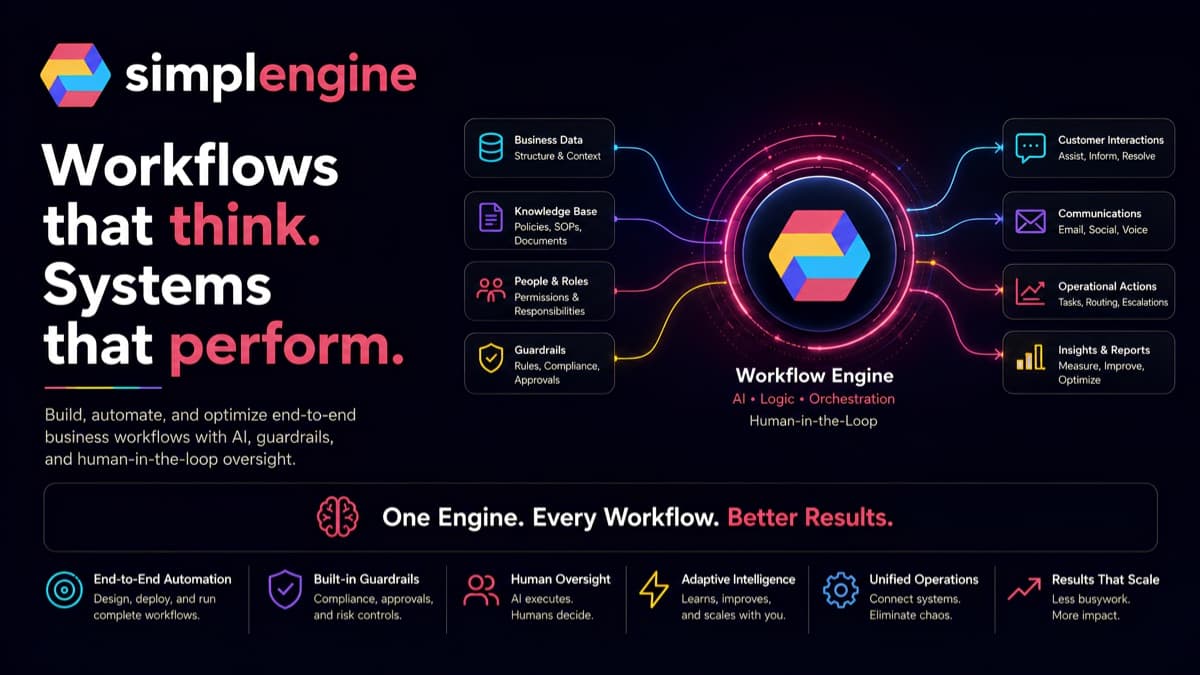
Most workflow automations do not fail because an API crashed or an LLM lost connectivity; they fail because nobody documented what the automation was permitted to do, what records it was forbidden from touching, and how team members should intervene when an unhandled anomaly occurs. When small and midsize businesses deploy AI steps without a structured runbook, minor schema shifts and ambiguous prompt completions quietly corrupt CRM pipelines, duplicate downstream records, and erode team trust.
A production automation runbook is not an aspirational slide deck or a theoretical architecture drawing. It is an operational contract that specifies the trigger conditions, input and output schemas, deterministic data guards, bounded AI judgment areas, human-in-the-loop approval thresholds, idempotency keys, and step-by-step incident recovery protocols before a single live event is processed.
Engineering a resilient runbook converts fragile, opaque automations into auditable business assets that any team member can inspect, debug, and safely pause. This operational guide provides the exact framework, technical parameters, and failure playbooks needed to document and run AI-assisted automations reliably across your operational stack.
/ 01
The anatomy of an automation runbook and why undocumented workflows fail
In production environments, unmanaged automations create compounding operational debt. When a workflow misfires without documentation, operators spend hours reverse-engineering trigger conditions, tracing untracked field updates, and attempting to reverse destructive writes across multiple business databases. As detailed by operational guides from [elfatranydesign.com](https://www.elfatranydesign.com/musings/how-to-automate-your-business-workflows), every dependable workflow must clearly delineate its trigger, required inputs, concrete outputs, and designated human owner.
An AI automation runbook standardizes these elements into a living operational playbook. It establishes what the workflow owns, the exact external systems it communicates with, the latency and execution limits enforced by the orchestrator, and the specific rollback steps required when an edge case halts execution.
- Identifies designated process owners, notifying engineering and operational leads instantly when exceptions occur.
- Eliminates mystery writes by defining authorized database endpoints, field mappings, and audit stamps.
- Establishes strict operational parameters for maintenance windows, credential rotation, and version retirement.
/ 02
Defining strict trigger boundaries and explicit negative scopes
A common point of failure in business automation is a vague trigger definition. Documenting a trigger as 'when a new form is submitted' invites catastrophic data drift when another department creates a separate intake form in the same workspace. According to architectural insights from [pravinkumar.co](https://www.pravinkumar.co/blog/automation-runbook-what-to-write-before-you-ship-2026), your runbook must specify the exact source webhook, URL endpoint, event payload identifier, and filtering conditions that qualify an event for execution.
Equally vital is documenting the negative scope—explicitly recording what the workflow must never touch. Without defined negative boundaries, lead enrichment scripts can overwrite manual sales notes, inventory bots can wipe custom ERP safety stock buffers, and support agents can resolve open billing disputes.
- Trigger specification: Document tool name, form ID, webhook path, payload structure, and firing event frequency.
- Exclusion criteria: Detail exact status tags, domains, user roles, or record types that must cause the workflow to abort gracefully.
- Negative boundary definition: Explicitly list read-only fields, protected database tables, and communication channels off-limits to automated writes.
/ 03
Enforcing source-of-truth schemas and deterministic pre-flight guards
Generative language models should never be tasked with basic schema validation, currency formatting, or data ingestion checks. Deterministic rules are vastly more reliable, cost-effective, and auditable than probabilistic model prompts. As highlighted in enterprise automation research on [makeautomation.co](https://makeautomation.co/end-to-end-process-automation/), foundational orchestration layers must maintain strict state machines, ensuring AI steps only execute when deterministic guards are fully satisfied.
Your runbook must catalog the required data contract for every pipeline stage. If an inbound payload lacks mandatory properties—such as a tax identification number, a valid email syntax, or a verifiable transaction ID—the automation must halt or route to triage before invoking any external AI API.
- Deterministic type validation: Validate string lengths, numerical thresholds, ISO dates, and regex patterns upfront.
- Source-of-truth lock: Identify the authoritative database for each data point to prevent bi-directional synchronization loops.
- Sanitization and PII redaction: Scrub sensitive customer payment details, credentials, and unnecessary PII prior to model inference.
/ 04
Bounding AI judgment steps with structured outputs and confidence scoring
AI capabilities should be deployed only where unstructured information requires bounded interpretation, such as parsing handwritten invoice line items, categorizing customer support intent, or drafting preliminary contract summaries. The runbook must define the strict bounds of this judgment, including temperature settings, system prompts, structured JSON schema constraints, and fallback behavior.
Every AI extraction or categorization step must return a confidence score alongside its structured response. As noted in process automation best practices from [aitoolsbusiness.com](https://aitoolsbusiness.com/automation-workflows/), workflows must enforce automated guardrails that divert low-confidence outputs into secondary review queues rather than pushing speculative classifications into production tables.
- Strict JSON schema enforcement: Reject model completions that fail strict type schemas or omit mandatory nested properties.
- Confidence thresholds: Establish unambiguous cutoff values (e.g., fields scoring below 85% confidence automatically flag for review).
- Deterministic fallbacks: Define default statuses and fallback paths when language models encounter token limits or content filters.
/ 05
Designing single-point human approval checkpoints and resume mechanics
Inserting approval checkpoints at multiple points across a workflow destroys operational velocity, while omitting them entirely introduces unacceptable risk. As analyzed by [logicoflogic.com](https://logicoflogic.com/guides/automate-boring-parts-starter-playbook), every high-stakes automation should feature exactly one dedicated approval checkpoint placed immediately before the irreversible action occurs—such as committing an ERP ledger update, issuing a customer refund, or dispatching an outbound email.
The runbook must document the exact mechanics of the pause-and-resume cycle. Modern orchestrators utilize native wait states or secure resume webhooks that display the AI-prepared draft, the source artifact, and a deterministic checklist of fields for the human reviewer to verify.
- Pre-commit approval placement: Gate money movement, contractual agreements, and external communications behind a single human checkpoint.
- Verification checklist: Provide reviewers with a structured side-by-side comparison of source documents and extracted values.
- Timeout and escalation policies: Specify what occurs if a reviewer fails to act within the defined SLA window (e.g., reassign after 4 hours).
/ 06
Implementing idempotency keys, reversible writes, and audit stamps
Network timeouts and API retries will inevitably re-trigger automation steps. If a payment, provisioning, or notification step is not idempotent, duplicate charges or double bookings will occur. According to operational controls outlined by [kriv.ai](https://www.kriv.ai/articles/ap-exceptions-and-3-way-match-agents-using-makecom), reliable automation architectures require unique idempotency keys generated from immutable event metadata.
Additionally, every record created or modified by an automated pipeline must carry an audit watermark. The runbook should require metadata stamps that record the scenario name, execution ID, timestamp, and model version, ensuring complete traceability for compliance and rollbacks.
- Idempotency keys: Hash source IDs (e.g., `SHA256(invoice_id + line_item_id)`) to block duplicate database writes on execution retries.
- Reversible write markers: Store pre-execution field states in an audit log to allow one-click rollbacks during data anomalies.
- Audit metadata stamping: Stamp all modified database entities with `_updated_by_automation_id` and `_run_execution_timestamp`.
/ 07
Failure classification: stop, skip, retry with backoff, or escalate
A critical section of any automation runbook is the failure matrix. Treating all errors identically leads to operational paralysis. A transient 503 gateway timeout from a vendor API requires an automated retry with exponential backoff and jitter, whereas a schema validation error indicates corrupted source data that must skip the record and log an anomaly.
Conversely, systematic anomalies—such as ten consecutive database write failures or unexpected credential revocation—must trigger an immediate emergency circuit breaker that pauses the scenario and pages on-call staff to prevent runaway pipeline damage.
- Retry with exponential backoff: Apply to rate limits (HTTP 429), server timeouts (HTTP 502/503/504), and temporary lock contentions.
- Skip and log: Apply to individual malformed records, missing optional fields, or records intentionally disqualified by negative scope rules.
- Emergency circuit breaker: Halt execution automatically if error rates exceed 5% of total volume over a rolling 15-minute window.
/ 08
Managing dead-letter queues (DLQ) and manual replay runbooks
When an automation exhausts its allowed retries, the failed payload must not vanish into an unmonitored log. Workflows must automatically route failed executions into a dedicated Dead-Letter Queue (DLQ) data store containing the original payload, failure timestamp, stack trace, and execution context.
The runbook must provide non-technical operators with step-by-step instructions for inspecting the DLQ, resolving data anomalies, and safely replaying failed messages without generating duplicate records or triggering out-of-order execution loops.
- DLQ payload capture: Persist raw input headers, execution trace IDs, and exact error responses in a searchable queue.
- Step-by-step triage guide: Document how operators correct common validation errors directly in the DLQ staging interface.
- Safe replay execution: Re-inject repaired records through dedicated replay endpoints that validate idempotency keys.
/ 09
Security, concurrency limits, and credential lifecycle governance
Automations operating across enterprise apps require rigorous access control. Hardcoding API keys or OAuth tokens directly inside workflow canvases creates extreme security vulnerabilities. The runbook should mandate centralized secrets managers and define least-privilege scopes for every service account.
Furthermore, operational runbooks must specify strict concurrency and execution limits. Without concurrency throttling, an unexpected bulk upload can trigger hundreds of simultaneous model inferences, exceeding third-party API rate limits and generating thousands of dollars in unexpected compute expenses.
- Centralized secrets management: Store API credentials in environment variables or key vaults with mandatory 90-day rotation schedules.
- Concurrency limits: Throttle maximum simultaneous execution threads to protect downstream ERP and CRM databases from connection exhaustion.
- Rate-limit management: Configure orchestrator batching and sleep buffers to operate within vendor API quotas.
/ 10
The production AI automation runbook specification and checklist
Before releasing an AI automation into a live business environment, engineering and operational teams should review the complete runbook against a standardized pre-flight checklist. This ensures that every edge case, security constraint, and rollback procedure has been documented and verified in staging.
Use the following operational specification template as your team's baseline requirement before moving any automated pipeline from staging into production.
- Metadata Header: Workflow name, version, primary owner, secondary escalation contact, and business critical level (Tier 1-3).
- Scope & Boundaries: Exact firing trigger, payload contract, exclusion criteria, authorized write tables, and forbidden data fields.
- Technical Guardrails: Pre-flight deterministic rules, AI confidence thresholds, single-point approval gate, and idempotency key syntax.
- Operations & Recovery: Concurrency limits, error classification matrix, DLQ triage instructions, and manual rollback checklist.
/ Practical takeaway
An AI automation runbook is the foundational operational document that prevents silent pipeline failures and data corruption. By defining strict trigger boundaries, deterministic validation gates, bounded AI judgment roles, single-point human approvals, and idempotent recovery workflows, businesses can scale automated operations with total predictability and governance.
Primary references
These sources support the factual and technical guidance in this article. Product decisions still require review against your own systems, policies, and risk.
Pravin Kumar on Automation Runbooks Logic of Logic Guide on Automation Playbooks MakeAutomation Guide to End-to-End Automation AI Tools Business on Production Automation Workflows Kriv AI Operational Controls in Agentic Workflows