
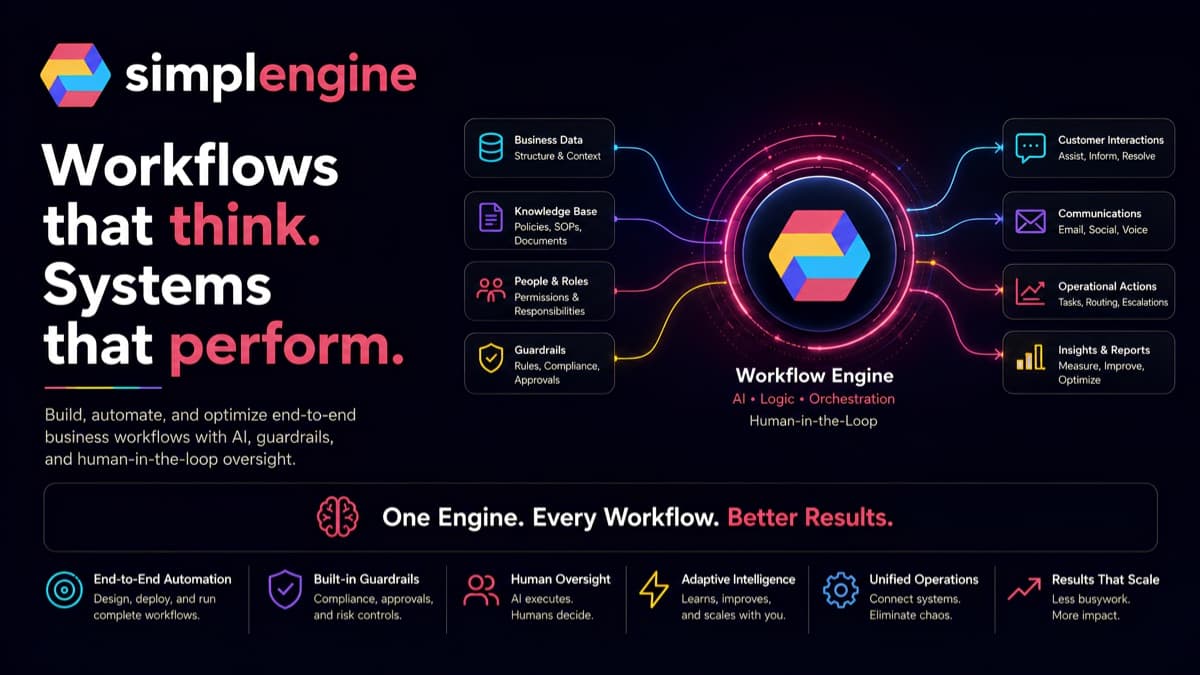
Most small and midsize businesses implement artificial intelligence to eliminate manual drudgery, only to find that their human team is spending more time babysitting automated scripts than they spent doing the original work. When an automation pipeline executes without adequate safeguards, it introduces severe operational risk; but when every single AI prediction requires a manager's manual click, the system becomes an expensive bottleneck.
The solution is not choosing between reckless fully autonomous agents and paralyzing manual oversight. High-performing operational teams build structured human-in-the-loop (HITL) architectures that clearly divide deterministic validation, probabilistic language model interpretation, and human approval checkpoints based on risk blast radius.
By establishing clear autonomy ceilings, durable workflow state, and idempotent execution paths, your business can deploy AI workflows that accelerate operations while keeping financial, legal, and client-facing decisions under firm human control.
/ 01
The bottleneck dilemma: why unmanaged human review stalls operations
Human-in-the-loop controls are frequently treated as an afterthought—implemented as a generic Slack message or email alert requesting a team member to review an unformatted payload. Within weeks, the review queue accumulates hundreds of notifications, reviewers experience approval fatigue, and they begin approving requests blindly without reviewing source records.
A poorly configured approval gate merely shifts the labor from task execution to notification triage. According to operational engineering analyses on agentic workflows at [jainmehul.com](https://www.jainmehul.com/guides/agentic-workflow-automation), an effective workflow must treat the orchestrator as the driver of the process rather than relying on an autonomous model to self-regulate its permissions. Without precise routing criteria and curated context, review queues create operational latency that negates the speed advantage of automation.
- Notification blindness occurs when high-volume, low-risk events trigger constant human interruptions.
- Incomplete review context forces operators to switch between multiple tabs to verify facts manually.
- Undefined review SLAs cause downstream tasks to stall indefinitely when approvers are out of office.
- Missing rejection routing leaves failed or modified tasks stuck in an unresolved state.
/ 02
Defining the autonomy ceiling and risk blast radius
Before adding an AI model to an operational workflow, you must calculate the blast radius of a potential error. Low-blast-radius tasks—such as categorizing an internal support ticket, drafting a CRM interaction summary, or formatting an intake note—have minimal downside if the model hallucinates or misclassifies an item.
High-blast-radius tasks carry financial, legal, compliance, or reputational consequences. Releasing an invoice payment, deleting customer records, altering vendor banking details, or dispatching binding contract language should never run unattended. As highlighted by [deveshjaiswal.com](https://deveshjaiswal.com/ai-automation-small-business-workflows/), deterministic rules must govern routine movements, AI should interpret variable inputs, and humans must retain explicit authority over high-consequence outcomes.
- Tier 1 (Zero Blast Radius): Internal drafting, data formatting, and classification run autonomously without manual intervention.
- Tier 2 (Moderate Blast Radius): Internal record updates and client communication drafts execute automatically only if confidence passes strict validation checks.
- Tier 3 (High Blast Radius): External disbursements, contractual commitments, and data deletions require mandatory human checkpoint approval.
- Tier 4 (Forbidden Autonomy): Master data credential updates and bank routing changes require dual-custody manual entry, completely excluding AI modification.
/ 03
Separating deterministic rules from probabilistic AI steps
A resilient automation architecture isolates the non-deterministic components of large language models inside bounded deterministic containers. Language models should never be the orchestrator of your database logic; they should serve strictly as specialized interpretation modules within a deterministic workflow engine.
As detailed in B2B workflow implementation guides on [farkeytech.com](https://farkeytech.com/ai-workflow-automation-example-scaling-teams/), combining strict business logic with isolated AI parsing prevents models from bypassing organizational policies. Your workflow platform handles event triggers, schema validation, mathematical calculations, and database queries deterministically, invoking the AI only when unstructured text or ambiguous inputs require translation into structured schemas.
- Pre-processing validation: Verify required fields, email formatting, and database IDs using deterministic regex and schema checks before calling LLM APIs.
- Scoped prompts: Constrain the model to return strictly typed JSON with closed-set enumerations and extraction fields.
- Post-processing assertions: Programmatically test that LLM outputs adhere to business constraints, such as ensuring extracted invoice subtotals mathematically equal line-item sums.
- Deterministic routing: Use rule-based conditional branches to evaluate whether the validated payload proceeds to automated execution or human review.
/ 04
Designing the approval payload for rapid decision-making
When an approval checkpoint pauses an automated run, the approver must not be forced to log into three underlying systems to figure out whether the action is correct. The orchestrator must compile an atomic review card containing the source data, the AI extraction, the specific reasoning, and the exact differential change.
Research on practical B2B workflow gates at [acxiomflow.com](https://acxiomflow.com/blog/ai-workflow-automation-guide) emphasizes that human-in-the-loop interfaces must provide simple interactive toggles, inline field corrections, and an audit trail field. Providing clear visual diffs reduces reviewer cognitive load from minutes to seconds while preventing rubber-stamp approvals.
- Source document link: Direct HTTPS pointer to the original email, PDF receipt, or customer message.
- Confidence metrics: Highlighted flags showing low-confidence extractions or conflicting fields.
- Proposed mutations: Clear before-and-after view of the exact database rows or external messages that will be written.
- Three-way action buttons: Single-click options for Approve, Edit & Approve, and Reject with mandatory reason selection.
/ 05
State persistence, durability, and idempotency across review pauses
A workflow that pauses for human review might wait two minutes or three days before an operator clicks approve. If your automation server restarts, redeploys, or experiences a connection drop during that pause, the workflow run must not vanish or execute duplicate transactions upon recovery.
Durable orchestrators persist execution state at every step boundary to an external database keyed by a unique run ID. As noted in workflow durability architecture on [jainmehul.com](https://www.jainmehul.com/guides/agentic-workflow-automation), every write action that touches external services must carry an idempotency key. This ensures that retrying a stalled or interrupted step executes the downstream action exactly once, preventing double payments or duplicate client emails.
- Durable step boundaries: Persist payload state to a relational database prior to triggering human checkpoint events.
- Stable correlation keys: Use deterministic hashing of entity IDs (such as invoice number and vendor ID) to generate unique idempotency keys.
- Safe resume hooks: Design webhook endpoints that accept approval signatures, verify caller identity, and resume the exact step without re-running earlier steps.
- Atomic state transitions: Mark the review task as claimed or completed immediately upon user action to prevent race conditions from concurrent reviewers.
/ 06
Timeouts, SLA escalations, and fallback routing
Every human-in-the-loop checkpoint must include a timeout strategy. An automation that halts indefinitely because an assigned manager is on leave creates silent operational gridlock. Production workflows require explicit fallback paths that trigger when approval SLAs expire.
Governance principles outlined by [cordrey.co](https://cordrey.co/knowledge/automation-governance-for-regulated-firms/) highlight the necessity of designated process owners and documented escalation procedures. When a review request breaches its time limit, the orchestrator should automatically reassign the task, notify a secondary queue, or execute a safe default fallback action.
- Tiered escalation alerts: Send a reminder after 4 hours, escalate to an operational team channel after 12 hours, and notify the process owner after 24 hours.
- Safe fallback defaults: If a non-essential task times out, route the item into an asynchronous backlog rather than failing the entire integration.
- Out-of-office delegation: Implement role-based queue assignments rather than hardcoding approval requests to a single employee's inbox.
- Emergency circuit breakers: Allow administrators to toggle global pause controls that temporarily bypass or queue automated steps during outages.
/ 07
Audit logging and compliance governance
Regulated firms and growing businesses must maintain comprehensive audit trails that prove who authorized an automated action and what data informed that decision. When an auditor or client questions an operational outcome, you must be able to reconstruct the entire decision lifecycle.
A compliant audit trail records the input payload, the raw model prompt and response, the validation scores, the identity of the approving user, the timestamp of the decision, and any manual edits made prior to execution. Integration platforms and custom backends must retain these logs in queryable storage separate from temporary execution caches.
- Immutable decision logs: Store inputs, model outputs, validation metrics, and human signatures in a dedicated append-only log table.
- Attribution metadata: Capture reviewer email, IP address, approval mechanism (Slack, web dashboard, or email link), and timestamp.
- Change tracking: Log field-level differentials whenever a human reviewer overrides an AI-generated recommendation.
- Log retention policies: Retain audit records in accordance with regulatory standards (typically 12 to 36 months) with automated archiving.
/ 08
The gradual autonomy roadmap: from shadow mode to sample review
Do not launch an AI workflow in full auto-pilot mode on day one. High-reliability engineering teams roll out automated workflows through progressive stages of autonomy, using statistical intervention rates to justify reducing manual checkpoints over time.
Start the workflow in shadow mode, where the system executes in parallel with your human team, generating suggestions without writing to external systems. Once validation confirms high precision, move to mandatory human approval. As your team establishes statistical confidence and low override rates, transition low-risk paths to spot-check sampling while keeping high-risk paths strictly gated.
- Phase 1 (Shadow Mode): AI generates draft records and recommendations in the background; humans perform the work manually; accuracy is benchmarked weekly.
- Phase 2 (100% Gated Approval): The automation builds the draft payloads, but 100% of actions pause at human checkpoints before execution.
- Phase 3 (Conditional Autonomy): High-confidence, low-blast-radius actions execute automatically, while low-confidence and high-value items route to human gates.
- Phase 4 (Sample Auditing): High-volume low-risk tasks execute unattended, while managers audit a random 5-10% statistical sample alongside all system exceptions.
/ 09
Implementation checklist: deploying safe human-in-the-loop workflows
Use this operational checklist to evaluate any new AI automation workflow before releasing it into production. Following these steps guarantees that your workflows remain auditable, durable, and resilient to third-party API changes.
- Identify blast radius: Document financial, legal, and operational consequences for every task failure mode.
- Enforce deterministic pre/post validation: Wrap LLM calls with strict JSON schemas, regular expressions, and business logic assertions.
- Implement state persistence: Ensure the orchestrator persists workflow state across restarts using stable database run IDs.
- Attach idempotency keys: Add unique hash keys to all external mutation calls to prevent duplicate executions upon resume.
- Design rich approval payloads: Provide approvers with source document links, extracted fields, confidence scores, and one-click edit tools.
- Establish SLA escalation rules: Configure automated reminder schedules and secondary approver routing for orphaned tasks.
- Build queryable audit tables: Store model inputs, system prompts, human override differentials, and user signatures.
- Test manual circuit breaker: Verify that operational leads can pause or disable the automation instantly without deploying new code.
/ Practical takeaway
Human-in-the-loop AI automation is not about having employees micromanage every automated step. By establishing deterministic guardrails, durable state persistence, rich approval payloads, and progressive autonomy ceilings, your business can eliminate operational bottlenecks while ensuring critical decisions remain firmly under human governance.
Primary references
These sources support the factual and technical guidance in this article. Product decisions still require review against your own systems, policies, and risk.
Agentic Workflow Automation in 2026: Practical Implementation Guide AI Automation for Small Business: 15 Practical Workflows Automation Governance for Regulated Firms: Practical Guide AI Workflow Automation Example for Scaling Teams B2B AI Workflow Automation Implementation Guide